Do-Soon Kim1,2,* , Tae-Kyeong Noh1, Min-Jung Yook1, Hyungsuk Kimm1
1Department of Agriculture, Forestry and Bioresources, Research Institute of Agriculture and Life Sciences, College of Agriculture and Life Sciences, Seoul National University, Seoul 08826, Republic of Korea
2Department of International Agricultural Technology, Graduate School of International Agricultural Technology, Seoul National University, Pyeongchang 25354, Republic of Korea
Correspondence to Do-Soon Kim, E-mail: dosoonkim@snu.ac.kr
Plant Image Sci. 1:1. https://doi.org/10.65971/PIS.2025.1.1
Received on December 17, 2025, Revised on December 24, 2025 , Accepted on December 30, 2025 , Published on December 31, 2025.
© Author(s). This is an Open Access article distributed under the terms of the Creative Commons CC BY 4.0 (https://creativecommons.org/licenses/by/4.0/) which permits unrestricted use, distribution, and reproduction in any medium, provided the original work is properly cited.

Plant image science is a new multidisciplinary science that involves imaging techniques and image analysis methods to capture, process, and analyze plant images for understanding plant status and responses to environmental perturbations across various plant types and ecosystems. Plant image science encompasses a broader range of concept and scope than plant phenomics making it differentiable and widely appreciable. It covers plant phenotyping and the diagnosis and remote sensing of individual plants, plant communities, vegetation, and living organisms (for example, microorganisms and insects). Relevant applications include but not limited to plant phenomics, plant breeding and genomic research, crop management, crop protection, agricultural machinery, and postharvest processes. Its conceptual flexibility and multidisciplinary nature suggest that it has virtually no limitations in its applications, making it an essential domain and tool for the future of plant-based sciences and industries including agriculture, forestry and environment.
diagnosis, phenotyping, plant image science, plant phenomics, precision agriculture, remote sensing, smart farming
Plant phenomics, as a branch of biology, includes studies of a hypervolume (i.e., plant phenome), which includes all the potential phenotypes that a specific genotype or genome can express under various environmental conditions (Zavafer et al. 2023). Plant phenomics is also the science that characterizes the plant phenome, the plant characteristics resulting from the expression of the genetic program stored in the cell under given environmental conditions (Ninomiya et al. 2019; Australian Plant Phenomics Network [date unknown]). Plant phenomics provides a more comprehensive insight by delivering complex phenotypes consisting of multiple quantitative traits (Finkel 2009), and has three major goals: 1) to capture information on the structure, function, and performance of large numbers of plants, together with their environment; 2) to analyze, organize, and store the resulting datasets; and 3) to develop models that can disentangle and simulate plant behavior in a range of scenarios (Tardieu et al. 2017). Despite differences in expression, these definitions consistently highlight plant phenotyping. Therefore, plant phenomics has focused on the phenotyping of plants as a result of interactions between genotype and environment.
Decadal advances in the quantitative assessment of plant phenotype have made a substantial contribution to plant science, specifically, plant breeding and genomic studies. In particular, rapid progress in sensing technologies – various spectral sensors, computer vision, spectral image analysis combined with artificial intelligence (AI), and automated indoor and outdoor remote sensing platforms – has fueled recent revolutionary advancements in plant phenomics. Genomics, on the other hand, cannot interpret all biological phenomena solely from genome sequencing data, and therefore, phenomics has become a crucial component of the omics cascade, linking genotypic data with phenotypic data to aid genome data interpretation. Recently, plant phenomics is largely considered a counterpart to plant genomics rather than an independent science overarching various research domains (Zhang et al. 2023). As the major scope of plant phenomics has become focused on genomic and breeding studies, relevant communities have overlooked further applications or potentials of phenotyping approaches, particularly plant imaging technologies, indicating that plant phenomics has inherent limitations regarding its definition, perspective, scope, and use. Therefore, in this review, we introduce a new concept, plant image science, to address its importance and potentials beyond plant phenomics.
Recently, a new scientific field called “Plant Image Science” has emerged. Plant image science is a branch of science that uses imaging techniques and image analysis methods to capture, process, and analyze plant images for plant and crop research and agricultural management (Noh and Kim 2018). Although its application appears to be confined to agriculture, it has virtually no limitations as long as plant images are used directly or indirectly. Compared with plant phenomics, plant image science is broader and more scalable in terms of both concept and scope. While plant phenomics mainly focuses on plant phenotyping for plant genomic understanding and plant breeding, plant image science encompasses plant phenotyping, the diagnosis and remote sensing of individual plants, plant communities, vegetation, and living organisms (for example, microorganisms and insects) in natural and agricultural environments. Plant images contain information about the shape, size, and color of plants (Fig. 1). Information on plant shape, including anatomical, morphological, phenological, and taxonomic traits, can be extracted from plant images using image analysis. Various quantitative traits related to plant shape such as growth, development, and agronomic traits can also be obtained. Qualitative traits related to plant color, including biochemical and physiological traits, can be extracted from plant images captured using different spectral imaging sensors. Individual and combined traits can be used for various purposes such as identifying and classifying plant species, crop varieties, insect pests, plant pathogens, and weeds; diagnosing plant responses to biotic and abiotic stresses and assessing plant and vegetation health; phenotyping plant and crop growth and agronomic traits; screening and selecting crop lines in breeding programs and pesticidal compounds in new pesticide discovery and development; recommending crop and field management practices; and remote-sensing of plant and vegetation in agricultural land, forestry and natural environment.
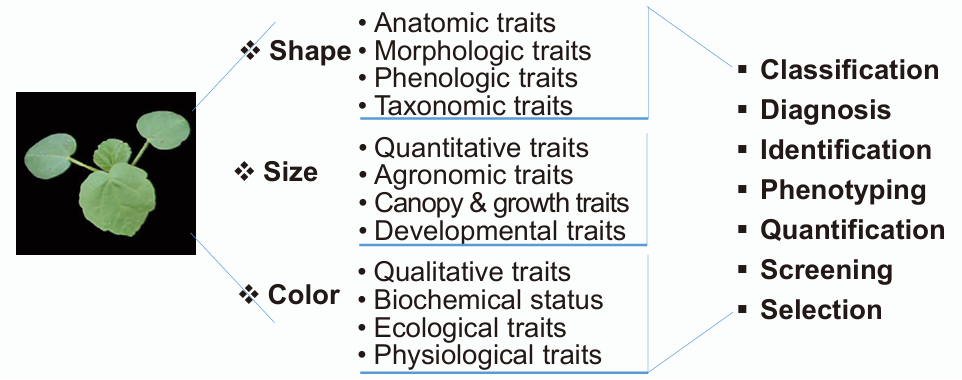
Fig. 1. Plant traits extracted from the shape, size, and color information in plant images, and their utilities for plant research and application.
Plant image science has a considerably broader scope in terms of concepts, imaging targets, and applications than plant phenomics that focuses on plant-level phenotyping with the goal of linking phenotypic traits to genomic information and supporting breeding studies. Unlike plant phenomics that mainly emphasizes high-throughput, standardized phenotyping of individual plants, often using automated facilities, plant image science extends beyond such phenotyping infrastructures and encompasses image-based analysis across diverse experimental settings and application domains. Plant images can be easily captured even with personal mobile phones, owing to the rapid advancement of imaging technologies, including infrared (IR) thermal and laser imaging, detection, and ranging (LIDAR) sensors, as well as increasing data storage capacities. The recent rapid progress in graphics processing units (GPUs) and AI has made image processing and analysis easier, faster, and more affordable. Internet of Things (IoT) technology also enables real-time sensing, data transfer, and decision-making based on plant images, allowing simultaneous monitoring and action for on-site agricultural and environmental management. Plant image science covers a wide range of targets from plant cells to entire vegetation and includes insects and pathogens that interact with host plants (Fig. 2). The signals and responses captured in the plant images range from germination to later growth, encompassing biochemical and physiological responses. For image acquisition, plant image science uses various spectral image sensors mounted on different platforms, ranging from small handheld devices to satellites. These platforms can be indoor or outdoor, as well as fixed or mobile.
Plant image science has considerably broader applications than plant phenomics. Its applications include not only plant breeding, but also crop management, crop protection, agricultural machinery, postharvest processes, genome research, as well as forestry and environmental monitoring (Fig. 2). Wherever plant image technology is applied, plant image science faces no limitations in its use owing to its conceptual flexibility and scalability. In contrast, plant phenomics is conceptually limited, focusing on plant phenotyping and restricting its application to plant breeding and genomic research. In the emerging scientific field known as plant image science, this discipline can be applied to fields such as crop science, horticultural science, forestry, plant pathology, entomology, pesticide science, weed science, molecular biology, plant breeding, plant genetics, post-harvest science, and agricultural machinery, indicating that plant image science can play a crucial role in the future of plant-based sciences and industries such as agriculture, forestry and environment.
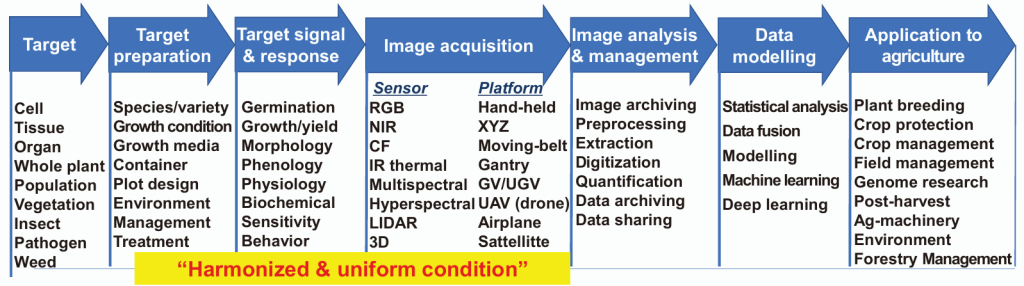
Fig. 2. Overall procedure and associated components of plant image science from the determination of imaging target to agricultural application. RGB, red-green-blue; NIR, near-infrared; CF, chlorophyll fluorescence; IR, infrared; LIDAR, light detection and ranging; 3D, three-dimensional; XYZ, xyz Cartesian coordinate system; GV/UGV, ground vehicle/unmanned ground vehicle; UAV, unmanned aerial vehicle; LLMs, large language models; Ag, agricultural.
Because of its scalability and multidisciplinary nature, plant image science is becoming an essential domain and tool in plant biology, agricultural research, and industrial applications. Recent rapid and innovative advancements in image sensing technology, IoT technology, image processing capacity, data science using AI, and robotics will expedite the contribution of plant image science to future agricultural innovation. The widespread use of large language models (LLMs) will enhance plant image science, making it more powerful and particularly useful for indoor and field smart farming.
We acknowledge our lab members, who have been dedicated to plant image science since its birth, and the members of the Korean Society of Plant Image Science, who co-founded the scientific community dedicated to plant image science.
Conceptualization: Kim DS; Writing – original draft: Kim DS; Writing – review and editing: Kim DS, Noh TK, Yook MJ, Kimm HS.
The authors declare no conflicts of interest.
This research was carried out with the support of the Korea Institute of Planning and Evaluation for Technology in Food, Agriculture and Forestry (iPET), Ministry for Food, Agriculture, Forestry and Fisheries, Republic of Korea (Project No. 321056-05-1-HD050).
No data available.
Australian Plant Phenomics Network (APPN). [date unknown]. What is plant phenomics? APPN; [accessed 2025 Dec 16]. https://www.plantphenomics.org.au/plant-phenomics/about-plant-phenomics/what-is-plant-phenomics
Finkel E. 2009. Imaging with ‘phenomics,’ plant scientists hope to shift breeding into overdrive. Science. 325(5939):380–381. https://doi.org/10.1126/science.325_380
Ninomiya S, Baret F, Cheng ZM. 2019. Plant phenomics: emerging transdisciplinary science. Plant Phenomics. 2019:2765120. https://doi.org/10.34133/2019/2765120
Noh TK, Kim DS. 2018. Weed research using plant image science. Weed Turf Sci. 7(4):285–296. https://doi.org/10.5660/WTS.2018.7.4.285
Tardieu F, Cabrera-Bosquet L, Pridmore T, Bennett M. 2017. Plant phenomics, from sensors to knowledge. Curr Biol. 27(15):R770R783. https://doi.org/10.1016/j.cub.2017.05.055
Zavafer A, Bates H, Mancilla C, Ralph PJ. 2023. Phenomics: conceptualization and importance for plant physiology. Trends Plant Sci. 28(9):1004–1013. https://doi.org/10.1016/j.tplants.2023.03.023
Zhang M et al. 2023. High-throughput horticultural phenomics: the history, recent advances and new prospects. Comput Electron Agric. 213:108265. https://doi.org/10.1016/j.compag.2023.108265